The subject of 'policing' often crops up, just as much in the pub as in politics. It's criticised for its leniency in some quarters and its heavy-handedness in others. Achieving a happy-medium is always going to be tough given the wide variety of subjective viewpoints which it generates.The British Airports Authority, now known as BAA plc and in charge of the security operation at Heathrow, would appear to be in something of a schizophrenic mood when it comes to the policing of their Heath Robinson-style trays, scanners and arches at Terminal 5 however.A couple of weeks ago, one of their constables of the conveyor belt decided to apply a zero-tolerance approach to some mashed potato which, inexplicably, appeared to be a liquid or gel in his black and white eyes. Confiscated it was and the poor passenger proceeded veg-less.Meanwhile, the policing of the system's Fast Track lane is rather more liberal. Approaching the guardian of the tensa-barrier, he simply said 'Fast Track, Sir?' And I simply said 'Yes.' Despite the fact that I did, of course, have the appropriate authority in my pocket, the simple utterance of an affirmative seemed to do the trick and I was through and out of the other side in 90 seconds. Whilst undoubtedly quick, one assumes that this somewhat laissez-faire attitude might ultimately cause one or two problems, but I shall leave you to ponder what those might be.Lounges apart, Terminal 5 presents a never-ending selection of opportunities to liberate currency from your credit card, as long as you can manage to avoid gassing yourself with the stomach-churning aromas eminating from the fast-food outlet at the head of the North escalators. When boarding is announced, it's pleasing to see that gate staff are finally getting the hang of boarding by row number and priority/at leisure boarding for shiny cardholders and business class passengers. A little more work to do on this though, as Club World passengers were summoned to this flight - which as a short haul operation was, to be accurate, offering a Club Europe cabin.The jetty pre-assessment of the crew suggested 'good-not-great', which again proved to be reasonably accurate. During the short, early-morning flight, service extends to a hot sandwich in EuroTraveller, and a tea and coffee run. With the humungous Sofitel breakfast still heavy on the belly, the sandwich was politely declined and coffee accepted instead. Which was, to be honest, pretty rotten but at least hot and wet.Arriving early into Zurich, it was a short walk to the airport's transit system, and one of those little things that gladden the heart every now and again; in this case, the high-speed video welcome from Heidi as the train shoots down its subterranean tube. It's not the smoothest of rides however, so Heidi is a bit jiggly:
 Passing through immigration and customs is fast and typically-Swiss in its efficiency, before exiting into the arrivals concourse. The quickest and best value way to reach the city is by train, and the station is a short walk across the forecourt and into another terminal area which is built above the platforms.Tickets can be purchased from machines which take cash only, and cash or card. There's a bank and an ATM in the vicinity, and a ticket office for advice, information or more complicated requirements than can be fulfilled by the machines.Particularly good value is the Zurichcard at a cost of CHF38, which affords unlimited tram and train travel for 72 hours within the Zurich canton, as well as numerous other attraction entry and travel benefits. I couldn't immediately see a button on the machine for the card (which is oddly only available for either 24 hours or 72 hours, but not 48), so the ticket office was called upon instead.Trains leave for the city every 10-15 minutes, with a variety of train types to be seen as the airport is on a mainline route. Some are sleek InterCity style models, others more run-of-the-mill double-decker commuter contraptions.
 All are clean, comfortable and spacious and take just 15 minutes to reach the city centre; look for Zurich Hauptbahnhof on the platform information boards.
 Final verdict for British Airways Euro Traveller: 7.5/10. There's not a lot of scope to shine on these shorthaul flights, but with seats no narrower than Club Europe and the same on-time departure and arrival as the front of the aircraft, there was little to consider unsatisfactory with the service. T5 was a breeze to get through (although BAA's security shenanigans are trying) and the service on board was friendly. The British Airways short haul seat remains one of the more comfortable too, in my opinion.
Zurich's Hauptbahnhof railway station is a grand edifice built on the banks of the Limmat River, which issues from the Zurichsee just a little way upstream. The station is well-connected with rail lines to all parts of the country and beyond, at both ground and basement floors and surrounded on three sides by a comprehensive tram network at street level.Exiting onto Museumstrasse and crossing the river, it's barely a 10 minute walk with light luggage to the Marriott Hotel which, thanks to its almost unique-in-Zurich high-rise stature, is plainly obvious from some distance away. Easy to locate it may be, but a thing of beauty it most certainly is not. Clearly designed by an architect untroubled by the concept of curves or radii, whose desk posessed only ruler and grey pencil, the Marriott rises like a giant, incongrous, duo-tone Sticklebrick from above the trees which line the clear-watered river's Northern bank.Once inside the lobby, things improve markedly - though only to that most reliable of Marriott rosy dark wood, granite, brass and marble combinations, with the ubiquitous portrait of the kindly-looking JWs, Senior and Junior, surveying the passing traffic from within their gilt-edged frame.Our Receptionist is most welcoming and confirms an upgrade in recognitoin of my Marriott Rewards Platinum status and, better still, advises that our room is ready despite the earliness of our arrival. He offers a city map and some brief suggestions of must-sees and points out the 'Golden Door' to the Club Lounge which that Platinum Card (and the upgrade) affords. A very positive first impression.Having gone from the gulagesque exterior to the clubby American lobby, it's something of a shock for the lift doors to open onto a guest room corridor which looks like that of a cross-channel ferry (although a richly-carpeted one) and smells ever so slightly like a municipal baths.The odd wall finish and flush nature of the guestroom doors gives rise to the impression that the doors themselves must open outwards, leading to a distinctly Midvale School For The Gifted tussle with the handle until it's realised that they do, in fact, open inwards.The other oddity experienced in the lift is that the hotel appears to have mislaid almost 20 floors. Either a significant chunk of the tower's midriff has collapsed, the hotel has size issues or there's a disconnect in the space-time continuum above floor four. I jumped up and down on the bedroom floor a couple of times and it didn't seem to wobble, so I'm guessing that option one is not the most likely of explanations.
 Once inside, it's back to standard Marriott again, and very comfortable too with the new 'Revive' bedding.
  The view is expansive back across the river, over the city and towards the Zurichsee. On a clear day, the Alps would feature in the distance.
 The bathroom is well-specified, spotlessly clean and stylishly fitted.
 The rate included a complimentary bottle of unspecified champagne, which the Receptionist had noted and asked what time it would be required. When it arrived, on time, it turned out to be more than acceptable and didn't last long whilst we enjoyed the view.
 The short stay didn't leave time to investigate the hotel's swimming pool and gym, but suffice to say that they're there and should meet the usual Marriott standards.The famed 'Golden Door' leading to the Club Lounge was passed through for pre-dinner drinks and a largeish room with a central servery was found behind it. Mornings bring with them a light breakfast presentation, followed by access to the coffee machine and sweet treats during the day. In the evening, a wider selection of canapes are brought out, and a bar set up.
 The cheeseboard is certainly to be recommended; the Montepulciano only if you propose to indulge in some evening paint-stripping whilst in Zurich. Avoid! There are both lounging and dining areas.
 There is a small business centre immediately adjacent to Reception, with PCs and secretarial services. Web access is chargeable however.The aforementioned light breakfast was passed over in favour of the more comprehensive offering served in the hotel's dedicated first floor breakfast room. Here, service was to the same friendly standard as elsewhere in the hotel, although the kitchen did seem to be struggling on this occasion to keep all the buffet items fully replenished. There's an in-room chef to prepare eggs and waffles, although the view is of a slightly Sega Racing flyover parapet.A late check-out was also included in the room rate and, when the time came, it was a quick and problem-free experience with no extras to add.Final verdict for the Marriott Hotel Zurich: 8.0/10. The hotel is a long way from being a budget option, so the lack of exterior presence and underwhelming corridors were something of a disappointment. Breakfast was not a completely seamless service and the Club Lounge suffered from a lack of free WiFi or PCs and some horrid wine. However, the overall value for money was good, the service first class and the bedroom clean, quiet, comfortable and with a more than pleasant view. A good, well-located choice, close enough to the centre to be convenient, but just a little away from the noise of the city.
Life's good in Zurich - and that's official. For eight consecutive years from 2001 to 2008, the Swiss city stubbornly came out top in human resources consultancy William M Mercer's quality of life index, which audits 215 cities worldwide. The predictably of the result would have become boring, had 2009 not brought with it the news that the city had fallen headlong down the rankings, to the civic pride-devastating position of second place. The Mercer study carefully measures 39 different criteria, including leisure and relaxation, safety, cleanliness, political and economical stability, and medical care. I have a sneaking suspicion, however, that the initial short-listing is undertaken on the basis of one single question: does the place look a bit boring?Experience shows that almost every city which triumphs in these regular 'liveability' competitions tends to lack a certain something in the built environment with which other, reportedly less 'liveable' cities might instantly be recognised. Take Melbourne, for example. You'd practically have to be a local to be able to immediately recognise the Arts' Centre or Flinders Street station.True, Vancouver has a stunning backdrop of mountains, but more than usually they're swathed in cloud and the unremarkable skyline could be any of at least a dozen waterside metropoli.And so it is that Zurich, often mistakenly considered to be the capital of Switzerland (no, that's Berne), would challenge even the most-travelled of cityscape identifiers were they to be presented with a skyline silhouette.A place to wow the new arrival this is not, then, but its charms grow more subtly and it doesn't take long to begin to appreciate the many subtle virtues that would indeed make this a most pleasant place to live and work. First though, let's get the money thing out of the way. The Swiss, and the good burghers of Zurich in particular, have one of the highest levels of personal income in the World. It's said that money doesn't make you happy, but as the Swiss know all too well, it does make you very rich.Since wealth tends to beget wealth, it's not only the locals who are to be found patronising the exclusive boutiques of the Bahnhofstrasse, and the surrounding networks of spotlessly-clean alleys and wynds. Oh no, those whose bullion sweats gently in the vaults of those famously shy banks clearly feel the need to come and look at their ingots regularly, perhaps to stroke them, polish them, or just file a bit off to go and buy an island. Or Zimbabwe.They fly in on SWISS, the only airline in the World in this global recession that is upgrading all its long-haul routes to carry a First Class cabin. They stay in hotels whose rates reflect mostly the weight-of-demand and spending-power of their guests, rather than any kind of relevance to anything of comparable standard outside the country. And then they drink and dine in perfect-people-watching open air cafes, or discreet restaurants where the discussion of dripping indulgence can be undertaken away from prying eyes and dropping eaves.
 Back to the Bahnhofstrasse though and, despite a few adjacent incursions from C&A and some rather communist-looking departments stores, it's an easy place to heat up a credit card on clothes, bags, perfumes and other branded goods.
 Venture beyond, leaving behind the artful plantpots of the current garden festival, and the streets become a mix of galleries and cafes, boutiques and speciality stores, with a notable prevalence of very expensive furnishing and homeware emporia. The Swiss, and their visitors, clearly like their cushions and cutlery. Indeed one purveyor of stylish ladieswear had felt the need to include a range of china in his window display: 'Oh, madame, that gown would look simply divine accessorised with this cruet. No? Perhaps a teapot then?'
 In the midst of this couture and crockery en route from the Bahnhofstrasse towards the river, the church of St Peter looks down on its parish of conspicuous wealth. It's certainly very pretty in an Alpine kind of way, but it holds a claim to fame that, at first glance, seems unlikely; believe it or not, St Peter's clockface is the biggest in Europe, and the largest church clockface in the World. At 8.7m in diameter, it beats Big Ben by 1.8m. That's slightly wider than a London Routemaster bus is long. Mind, if you think that's big, you want to see the size of the cuckoo.....The small hill to the West of St Peter's is the Lindenhof, which has been inhabited since 1500BC. It's not immediately apparent that much has been done to upgrade it since, although it does at least get a note in the history books. It was the site of the citizens of Zurich swearing their oath of allegiance to the Helvetic constitution in 1798. These days, it's a grassless park which does however represent a good vantage point from which to survey the Limmat River and the buildings of the North bank.
 Most obvious amongst these is the Grossmunster, a Romanesque church completed in 1220 with iconic (well, as iconic as Zurich gets) twin towers that were added in the 18th Century following a fire.
 In front of the Grossmunster when viewed from the grandstand of the Lindenhof, and built almost in the river, the Renaissance-style Rathaus anchors the wide promenade of the Limmatquai at its Eastern end. Reached by way of the eponymous bridge, the Rathaus plays host to an adjacent and uber-stylish cafe and bar. From its large open-air terrace, customers may observe the passage of time and talent from the comfort of deeply-cushioned rattan sofas and armchairs, shading their sprayed-on tans from the natural elements beneath wide canvas canopies.
 Those less keen on being quite so seen (or seeing so much) might chose to cool their heels instead a little closer to St Peter's, at the pavement cafe of the Hotel zum Storchen in Am Weinplatz. Though the people-watching is slightly poorer, the daytime selection of food at this still-riverside cafe is more comprehensive than at the Rathaus, including some very good salads and ice creams.If the area to the South of the crystal-clear waters of the Limmat is the shopping mecca of the city, then that adjacent to the Rathaus and the Grossmunster is undoubtedly the focus for dining, drinking and nightlife.
 There are all manner of nightclubs and bars catering to the various predelictions of their target clienteles, including a quite spectacular number of 'exotic' establishments aimed primarily at the single gentleman. In fact, it doesn't take a walk of the streets to note this; the free official city guidebook carries 11 full-page adverts for these providers of short-term companionship.When in Zurich, it might be considered de rigeur to do the Swiss 'thing' and sample the domestic cuisine at a restaurant such as the well-located Swiss Chuchi. Forming the ground-floor of the Hotel Adler, the outdoor seating area at Swiss Chuchi is yet another great place from which to observe the flow of humanity heaving past. The service is friendly, but it quickly becomes apparent that the Swiss would no more dine (or pay the prices) here than yodel the day's gold price from a cereal bowl-selling dress shop.
 What they do, it transpires, is walk past the place and stare at the entirely bizarre vista of tourists toasting bits of native vermin on George Foreman grills attached to extension cables that snake across the cobbles. Meanwhile, they wander off for a far more sensible pizza.
You live and learn.Cheese-somothered rabbit aside, Swiss Chuchi is still a marvellous viewfinder through which to watch the promenading locals outside who, it seems, evolve from handsome and well-dressed in the twilight, to ever more exotically-attired as the evening progresses. Alongside these displays of vestments which even Joseph would probably considered a bit garish, it also transpires that Zurich does a good line in chavs and stag parties, ladettes and hen nights.They're way off the pace though, at least compared to their Anglo Saxon counterparts; they may wear the uniform of Nike and Lacoste, but their cheery hellos and twin-cheek kisses of greeting between passing stag/hen combinations give them away as amateurs. They will never cut it against the finely-honed perfection of the genre, represented by the 2 litre bottles of cider and vomit crusted crop-tops that are the British way.
The Swiss, it seems, also have much to learn.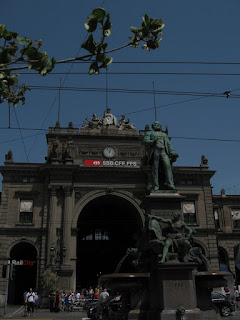 To clear the head after a night of doubtful health and safety, the comprehensive tram network will deliver the visitor almost inevitably at some point, along any of its routes, to the Hauptbahnhof and, from here, the S10 train ascends a steep and winding track, first through the suburbs and then through trees and meadows to Uetliberg.
 From the picturesque station, numerous walks fan out - ranging in lengths from a gentle stroll to multi-day hike. Most visitors, if they can drag themselves away from the platform tearoom, make the 10 minute climb to the summit of the 873m high hill by way of some steps and a wide track, sentried by some rather esoteric lamp standards.

Arriving relaxed and with the assistance of the S10, it's something of a surprise to find the top of the hill thronged with sweating lycra-clad cyclists, gasping for air and dousing themselves with bottles of water. Perhaps they didn't know that there's a train.
 Hills are, of course, things that the Swiss do rather well. By contrast, it's probably fair to say that no-one does hills as badly as the British. This particular Swiss mini-mountain has a railway, a station, a cafe at the station, two hotels, numerous picnic areas, a bar, a sausage and ice-cream kiosk, a terrace, an additional viewing platform and a radio transmitter.
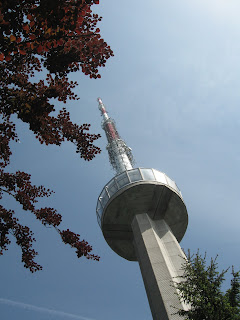 Back home, you're lucky if you get a dry stone wall to wee behind and even then you're apt to zip up and find a mono-toothed farmer with a baying hound bearing down on you.Uetliberg is therefore a 'top hill' and the Swiss are to be commended for making it accessible to everyone, not just to those with a waterproof and napsack fetish. And I'm sure that those cyclists will know for next time.Anyway, from the aforementioned viewing platform, there's a 360-degree panorama which extends from the underwhelming skyline of the city in front, around to the sparkling waters of the Zurichsee and then further to the folded valleys hiding Winterthur and then back to the city again. On a clear day, the Alps provide a most impressive backdrop.
 Once back in the city, it might be considered prudent to augment the observation of wealth with a little culture, the most obvious bastion of which is the Swiss Museum, the Schweizerisches Landesmuseen. Conveniently located next door to the Hauptbahnhof and therefore a neat continuation of an Uetliberg trip, the museum houses Switzerland's most comprehensive cultural and historical collection, covering pre-history, antiquity, the Middle Ages and on to the 20th Century.
 Fans of the dramatic arts are also well-served with impressive venues, epitomised by the mighty Opera House on Falkenstrasse. One of Europe's leading stages, the venue is known for its breadth of repertoire and is popular with traditionalists and supporters of modern interpretation alike.
And with that rather obvious link to the potential for a stereotypically-large lady to begin warbling, our 24 hours in Zurich is over without a triangle of Toblerone ever having passed our lips.


